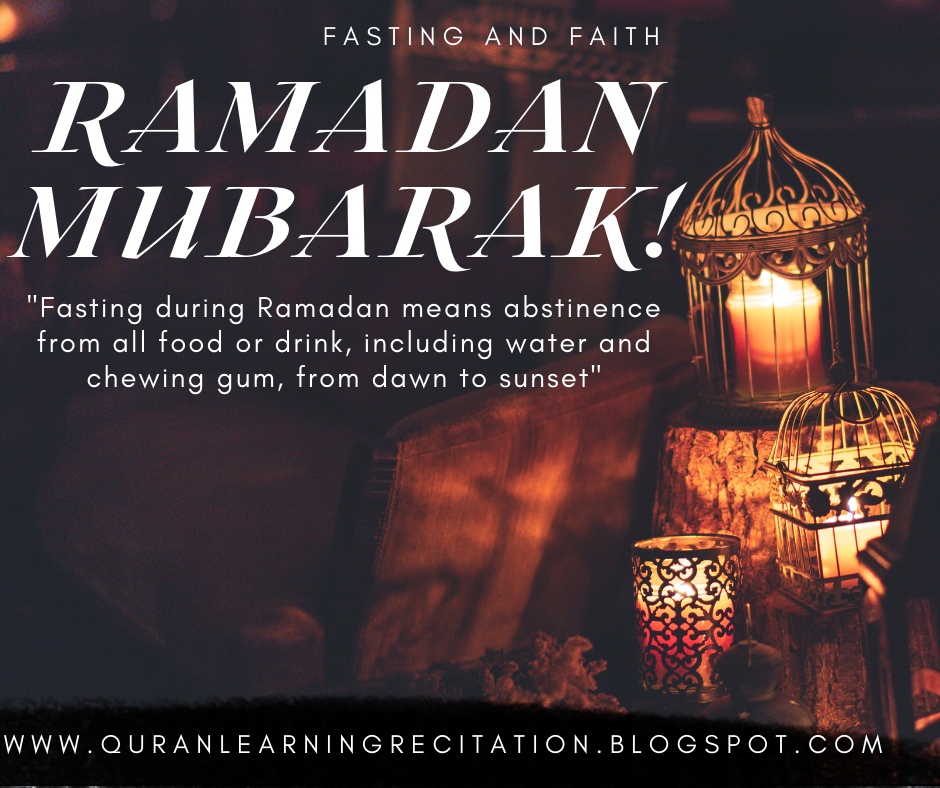
Quran Learning Recitation: Benefits of fasting

Hot

Post Top Ad

Showing posts with label Benefits of fasting. Show all posts

Thursday, 22 April 2021

What is Ramadan? | Importance And Benefits Of Ramadan

15:25 1
The Holy Month of Ramadan

What is Ramadan?

Ramadan is the ninth month in the Muslim lunar calendar. Healthy adult Muslims fast in Ramadan from dawn until dusk. This includes abstaining from drinking, eating, immoral acts, and anger. Other acts of worship such as prayer, reading the Quran, and charity are also encouraged during the holy month of Ramadan.

The holy month of Ramadan is once again upon us. While most of us will be fasting and praying and seeking Allah’s blessings in this month some would be spending even more time in extra prayers and remembrance of Allah. Every year Ramadan offers a kind of transcendental experience for many Muslims.

Muslims also believe the Quran was revealed in Ramadan.

During the holy month, Muslims wake up early to eat a pre-dawn meal called suhoor, and they break their fast with a meal referred to as iftar.

It is common for mosques to host large iftars, especially for the poor and needy. Nightly prayers called Tarawih are also held in mosques after iftar.

Different cultures have different traditions during Ramadan, whether it is a special food they must cook, or eating iftar with the extended family. Islamic tenets such as generosity inspired most of these traditions, including sharing food and inviting guests over for iftar.

When is Ramadan?

Since Ramadan is part of the lunar calendar, its date annually changes on the Gregorian calendar. Muslims tend to wait for the new month’s moon to appear before they announce the first day of Ramadan. However, they can still estimate the day beforehand.

This year Ramadan begins on Friday, April 24 in most Muslim-majority nations.

How long is Ramadan?

Lunar months last between 29 to 30 days depending on when the new moon is sighted. If the moon is not seen on the night of the 29th day, then Ramadan lasts for the full 30 days.

The Eid al-Fitr celebration marks the end of the month when Muslims celebrate a successful Ramadan of fasting and worship.

Why do Muslims fast during Ramadan?

Fasting is one of the five pillars of Islam. There is also a verse in the Quran that prescribes fasting for all Muslims who are mature and healthy enough to do so for the full day.

Fasting is also seen as a way to learn patience and break bad habits.

Importance And Its Benefits

The month of Ramadan 2021 is one of the most blessed and rewarding months of the Islamic calendar. Muslims from around the world observe fasting from dawn will dusk. Fasting cleanses a believer’s soul of his past sins. It invokes a sense of humility, righteousness, punctuality, self-restraint, and brotherhood for fellow Muslims. Here are some of the many benefits and the importance of this blessed month.

Attain Taqwa

Fasting helps a Muslim attain Taqwa or the fear of Allah (SWT) and His Wrath. Taqwa invokes a Muslim to practice self-discipline and self-restraint as he fights his urges for all things immoral, makrooh, or haram. Fasting offers Muslim protection and is an excellent way of observing some serious self-reflection and how to become a better Muslim in order to please the Almighty whilst simultaneously preparing for the Hereafter.

The door of Heaven is Open

In the holy month of Ramadan, the gates of hell are closed and the devil is chained. The doors of heaven are open. There is a door in Paradise called Al-Rayyan which is only meant for those believers who observed fasting during Ramadan.

Multiplication of Rewards

The month of Ramadan is the most rewarding month amongst all the Islamic months. During Ramadan, Allah (SWT) multiplies a Muslim’s rewards for worship and good deeds by 10, 70, 700 times.

Repentance and the Last Ten Nights of Ramadan

Allah showers His mercy upon the Muslims, especially during these last 10 nights. In them, du‘ā’ is answered particularly quickly, and especially after one finishes a complete reading (khatm) of the Qur’ān (the best time to complete the last suras in the Qur’ān is either right after Fajr or right after Maghrib and since the nights are so significant, it would be better in to finish it right after Maghrib during the last 10). Also, Allah forgives many, many people and frees them from the Hellfire – so it is recommended to repeatedly ask Allah for forgiveness with a heart that is present and focused on Him, Exalted is He! Also, O Believer, these are the days which the Beloved Prophet, peace, and mercy be upon him, described as the days when Allah frees people from the Fire. So be alert and make use of these days in worship and repentance.

Repentance and the Last Ten Nights of Ramadan

Throughout Ramadan, especially the last ten nights, Muslims seek forgiveness (Sha’faat) from Allah the Almighty to cleanse their body and soul of past sins and misdeeds. Spending the last ten nights awake earns a Muslim reward, blessings, and forgiveness for his efforts. For those who spend the last ten nights in Itikaf, in addition to earning rewards, they get a chance to self-reflect, attain peace of mind, and become patient.

Probably the greatest blessing within these last 10 nights is that Laylat Al-Qadr [The Night of Great Value] is hidden somewhere within its odd nights. It is related by Imām Aḥmad (a sound hadith) that the Prophet, peace, and blessings be upon him, said, “Laylat Al-Qadr is within the 10 remaining days. Whosoever stays up [in prayer/worship]… Allah, Most Exalted, will forgive all his [or her] past and future sins. And it is on an odd night, the 9th, or the 7th, or the 5th, or the 3rd, or the last night.”

Health Benefits

Fasting not only purifies a Muslim’s soul but also his body. Fasting helps reduce weight and rejuvenate the body as food consumption is modified and the body gets a chance to cleanse itself of unwanted impurities and toxins.

Fasting has many benefits for the body as well as for the mind. It gives the body some needed respite provided one does not indulge in the night. And the rigorous discipline and code of conduct that has to be observed daily as part of fasting and for as long as thirty days contribute to one’s patience, tolerance, and overall wellbeing. These are by themselves great health benefits of fasting.

Ramadan brings with itself countless blessings and benefits. Observe fasting in Ramadan to be rewarded in this world and the Hereafter.

Read More

Thursday, 12 March 2020

What are the Manifold Benefits of Fasting in Ramadan

00:58 0


Allah, the Most Wise, has prescribed rites that are good and beneficial to humankind. Since He is Self-Sufficient and free of all needs, Islamic rituals such as prayer and fasting in Ramadan are only advantageous to Muslims. This is why fasting, with its manifold blessings and benefits, was made compulsory on all past nations.

Fasting on all past nations

“O, believers!  Fasting has been prescribed for you as it was prescribed for those before you in order that you become more conscious of God.” (Quran 2:183)
·         In Hinduism fasting is known as ‘upavaasa’ and is observed on special occasions
·         In Judaism fasting is undertaken on ‘Yom Kippur’
·         In Christianity, Catholics fast during the season of Lent
And finally, Muslims are obligated to fast in the Holy month of Ramadan, which is the 9th month of the Islamic lunar calendar.

The Manifold Benefits of Fasting in Ramadan

On top of this list is the fact that fasting is considered the best of deeds and one that Allah will personally reward believers for. When the Messenger of Allah (PBUH) was questioned:
“Which is the best deed?”  He replied, “Fasting, for there is nothing equal to it.” (Nasai)

The benefit of fulfilling a religious rite

This is about adhering to the fundamental rules of fasting, which are to stay away from food, drink, and sexual relations between dawn and dusk. This should be for the entire period of Ramadan. It is merely the fulfillment of an obligatory fourth pillar of Islam from which a Muslim stands absolved. There are no additional spiritual, physical, or psychological gains to be had via this aspect of fasting.

The physical benefit of fasting

The physical benefit of fasting becomes apparent when done correctly and in harmony with the Prophetic Sunnah. The Messenger of Allah (PBUH) would typically keep his suhoor and iftar light. According to him:

“The worst container a human being can fill is his stomach.  A few morsels of food to keep a person’s back straight are sufficient.  However, if his desire overcomes him, then let him eat a third, drink a third, and leave a third for breathing.” (Ibn Majah)
Hence, by not eating during the fasting hours and eating in moderation during the feasting ones, the physical benefit of fasting is able to shine through. A Muslim is able to feel the pangs of hunger the poor and needy feel daily. This makes him physically aware of their sufferings.

The health/medical benefits of fasting

Medical science has acknowledged the numerous health benefits of fasting. It is also found to prevent health problems and improve mental illness. Some of the vital health benefits studied include:

·         Fasting Helps Weight Loss
·         Fasting Improves Insulin Sensitivity
·         Fasting Speeds Up The Metabolism
·         Fasting Promotes Longevity
·         Fasting Improves Hunger
·         Fasting Improves Your Eating Patterns
·         Fasting Improves Your Brain Function
·         Fasting Improves Your Immune System

The libido-related benefits of fasting

The sexual instinct and drive are curbed through fasting. During fasting hours, Muslims show self-restraint and protect their gaze, ears, tongue, and private parts from falling into haram. They make an extra effort to stay away from obscenity and nudity, knowing it could undermine their fast.

It is an ideal way to lower the libido and control the sexual urge. The Prophet (PBUH) is known to have advised those young men who had no means to marry, to fast instead.
“O youths, whoever among you is able to marry, let him do so, for it restrains the eyes and protects the private parts.  He who is unable to marry should fast because it is a shield.” (Bukhari)

This self-control becomes a habit when exercised repeatedly for a period of 29 or 30 days. A Muslim realizes the blessings of adhering to Allah’s command of lowering the gaze and clings on to the acquired habit even after Ramadan. The likelihood of falling prey to pornography and nudity is thus minimized or negated.

The emotional benefits of fasting

Fasting helps in curtailing all kinds of negative emotions. A fasting person is expected to be on his best behavior. Unfavorable emotions like anger, envy, hatred, pride, and arrogance are best avoided. Argumentation, even if one is right, is disapproved of. It is said that fasting shields one from all sins unless one weakens.                                    
The Holy Prophet (PBUH) stated:
“When one of you is fasting, he should abstain from indecent acts and unnecessary talk, and if someone begins an obscene conversation or tries to pick an argument, he should simply tell him, ‘I am fasting.’” (Bukhari)
Even when provoked, a fasting Muslim should excuse himself from the invitation to indulge in the impermissible. This is why the month of Ramadan is considered a ‘Training Period’ for Muslims.

The psychological benefits of fasting

While fasting, a person remains consciously aware of his thoughts and actions. He is careful to avoid all that his mind tells him will earn him Allah’s displeasure. This attitude of abstinence, aided by reasoning, makes a Muslim God-conscious in all he says and does. By taming his evil thoughts and working on his character, a fasting person is able to give up grave sins such as lying. Our beloved Prophet (PBUH) said:
“Allah has no need for the hunger and the thirst of the person who does not restrain himself from telling lies and acting on them even while observing the fast.” (Bukhari)

Thus, for his fast to be deemed a fast and not mere starvation, a fasting person must cultivate himself both emotionally and psychologically.

The spiritual benefits of fasting

Spiritual growth and purification is the most compelling and rewarding benefit of fasting if mastered. The primary aim of fasting is to draw closer to Allah SWT. This must begin from the very depths of one’s heart, as actions are judged by intentions.
A fasting Muslim’s spiritual growth and worth are known to Allah alone. No one else knows how sincerely he prayed through-out Ramadan. Only his Lord knows about all the charity he gave away.
The inner struggles that he overcame with Allah’s help during Ramadan are a mystery to his loved ones but known fully by Allah. Thus, it can be safely concluded that an individual’s spiritual growth is Ramadan’s primary objective.
The deeper the sincerity, God-consciousness, and submission to Allah’s guidance, the higher the chance of securing Allah’s pleasure:
“Every act of Adam’s descendants is for themselves, except fasting.  It is meant for Me alone, and I alone will give the reward for it.” (Muslim)

Read More

Post Top Ad

Your Ad Spot